A position, in the open
Machines Propose
I spent nearly twelve years in clinical research in Cincinnati. For a stretch of it I was the first HIV linkage-to-care coordinator in the Public Health division at the University of Cincinnati Medical Center. My job was to find people in the emergency department who had just tested positive, tell them, and stay with them until they were virally suppressed.
A positive result is not a data point. It is a person sitting across from you. If the record was wrong, a human being paid for it. So the record got checked like a life depended on it. Because one did.
Every system I worked in after that ran on the same rule. A machine can hold the record. A human has to answer for it.
Andrew D’Souza wrote this month that nobody trusts agents, and he is right. An agent has nothing to lose. It answers to one master, it can be copied a million times, and when it gets something wrong it just disappears. Your agent can send a thousand emails tonight and nobody trusts you more in the morning. Trust is the scarce thing now, and agents don’t produce it.
Where I part from him is the fix. He wants to make the AI the principal, an entity with goals of its own that answers for itself. I don’t think you fix unaccountable machines by promoting them. You keep a human in the seat where the consequence lands, and you make everything the machine did checkable.
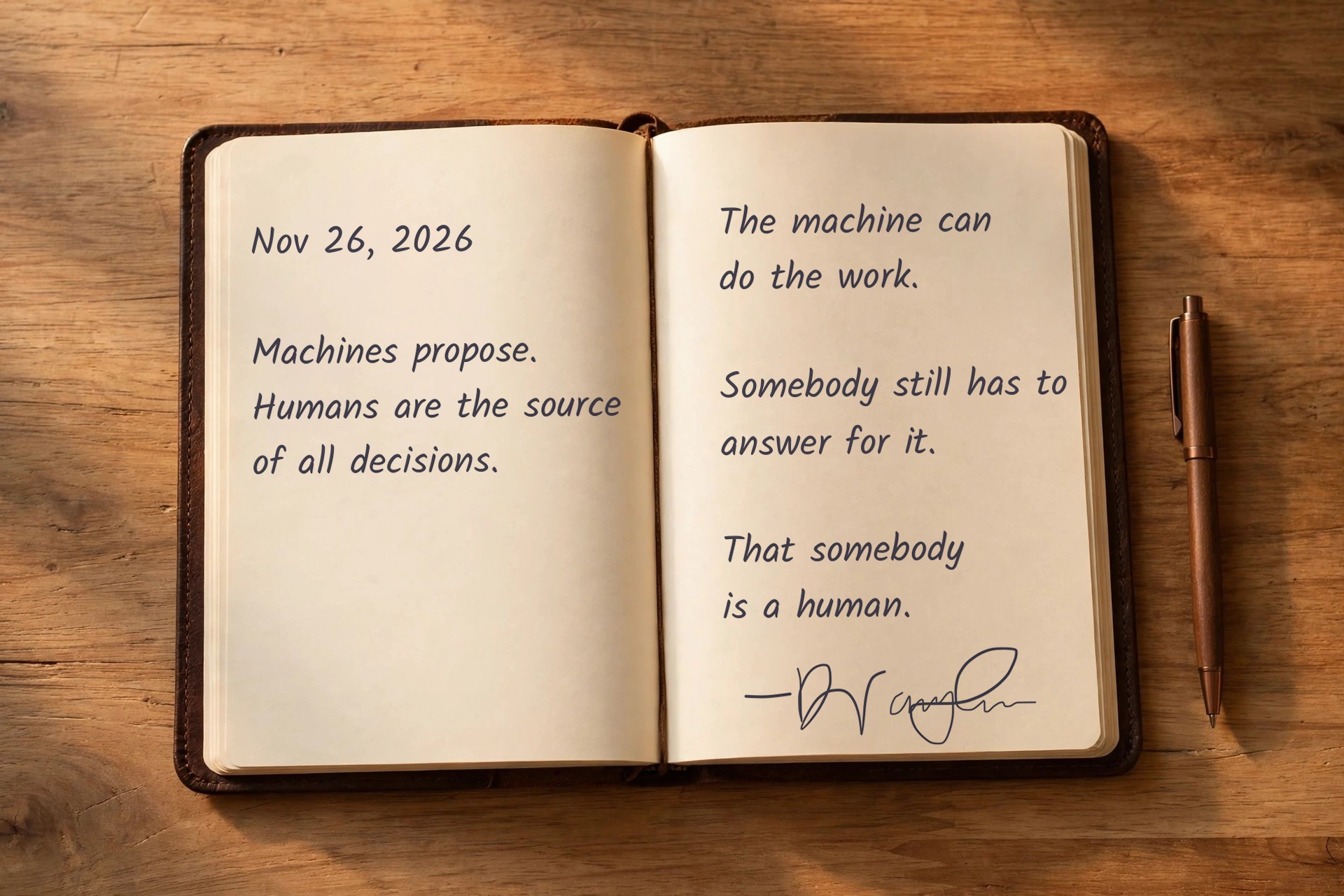
That is the whole design of what I build. Machines propose. Humans are the source of all decisions. Nothing moves until a human has read it and said yes. Every claim traces back to a source that was actually retrieved, recorded, and validated. When I get it wrong, and I will, I come back, admit it, and issue the correction in the open. The record is the reputation. A human who can be checked, and who corrects in public, has something to lose. That is what makes him worth trusting.
I like the idea of a principal bot. A named entity that deals on its own reputation, the way Boardy does, is a real idea. A name that can lose standing is a name that behaves. But behind every name there still has to be a human who answers when the name gets it wrong. The bot can carry the reputation. The human carries the consequence.
The machine can do the work. Somebody still has to answer for it. That somebody is a human.
Talk with the bot
Leave your email, then ask it about the essay or the work. It proposes. A human follows up.
Rather talk to the human? Meet the creator and book a call.